At Google I ran the India Edu Program by Google for Developers from 2022 to 2025 — an education-first developer program that reached 200+ institutions and 200K+ learners across cloud skills, Gemini adoption, and K-12 AI enablement.
The 60K+ Gemini API developer adoptions the programme drove did not come from a launch campaign. They came from a faculty enablement pattern that turns one trained instructor into a cohort of adopters. This is the teardown.
Why campaigns under-produce on API adoption
The default play for driving API adoption is a launch campaign — blog posts, social pushes, developer workshops, sample repos. It works. It also has a ceiling.
The ceiling is that a campaign is trying to acquire developers one at a time. Every impression, every workshop seat, every sample repo star is an individual conversion attempt. The unit cost is the impression cost divided by the conversion rate. For a scale like 60K adoptions, the math on a pure campaign is expensive and slow.
The other reason campaigns under-produce is follow-through. A developer who tries the API once at a workshop and never opens it again is not an adopter — they are a completed workshop attendee. The metric flatters the workshop. It misses whether the API became part of their default toolkit.
The multiplier
The India Edu Program had access to something a campaign does not — 200+ institutions with faculty who teach developer courses. That is a category of person who does one thing a developer does not: they hand out an API to a cohort of students who will use it as part of coursework for a semester.
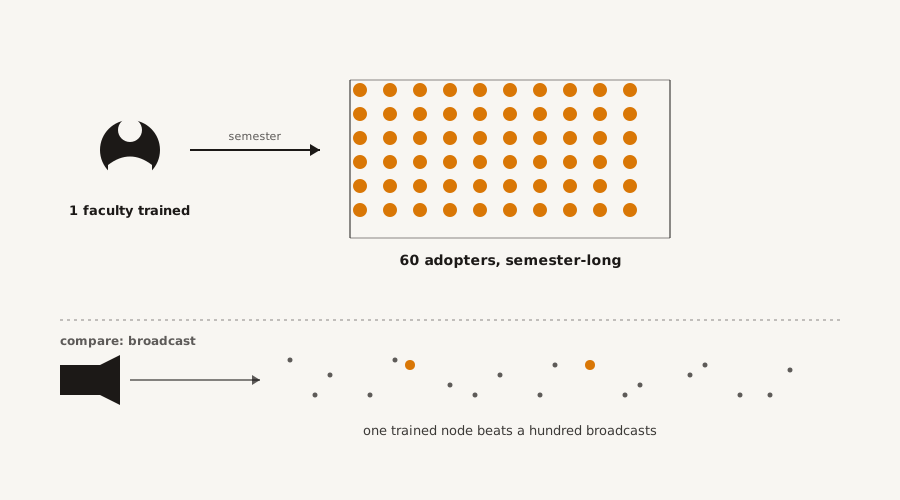
One faculty member trained on Gemini, teaching a course of 60 students, produces 60 authentic API adopters. The unit cost is the cost of enabling one faculty member. The follow-through is built into the semester structure.
| Acquisition path | Unit | Follow-through |
|---|---|---|
| Campaign to individual developers | One impression → one attempted conversion | Depends on the developer's own initiative |
| Workshop to individual developers | One seat → one attempted conversion | Ends when the workshop ends |
| Faculty enablement | One trained faculty → one cohort of enrolled students | Built into the semester assignment structure |
The multiplier is the whole design. Everything else — the workshops, the sample code, the language coverage — sits underneath it.
What the enablement pattern actually looked like
The pattern was not novel. Its execution was what made it work at scale.
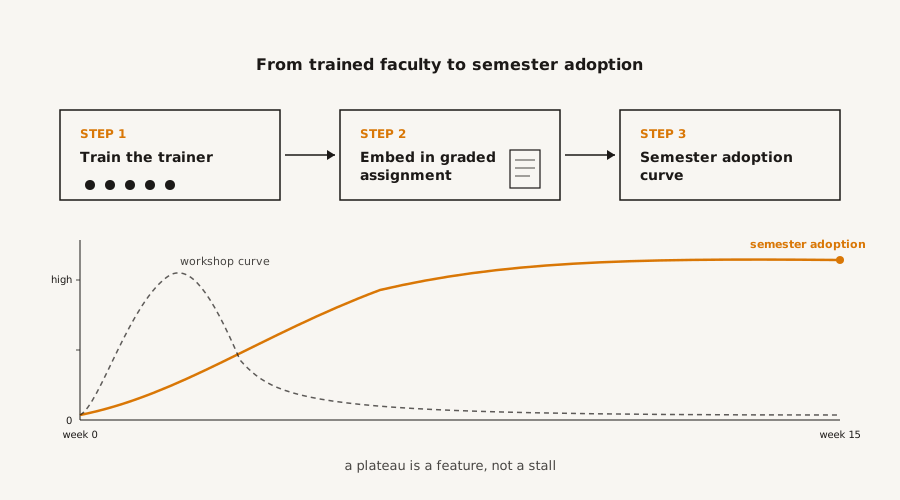
Train the trainer. Faculty from partner institutions were trained on the Gemini API through structured sessions — not a one-off webinar, but a train-the-trainer cohort with a defined curriculum and completion criteria. A faculty member exited the cohort with the material and confidence to teach the API to their students.
Embed in course assignments. The trained faculty then embedded the API into an actual course as an assignment. Not an optional lab, not an extra credit exercise — a graded assignment that produced student-side API usage during the semester.
Measure the semester, not the workshop. The metric that mattered was student adoption during and after the assignment cycle. A workshop metric would have counted the training completion; the real number was the API activation curve that followed the semester calendar.
The K-12 extension
The same pattern extended into K-12 through Gemini for K-12 and the AI Educator Series, which ran in seven Indian languages. K-12 teachers do not use the Gemini API directly, but the pattern still holds — a trained teacher exposes a cohort of students to the concept, and a fraction of those students later become developers who adopt the API by name because they have already met it. That is a slower, longer-horizon multiplier and it does not show up in a quarterly adoption number. It matters for the shape of the ecosystem five years out.
Language coverage mattered here in a way it did not for the university faculty programme. A K-12 module in English reaches teachers who already teach in English. Seven-language coverage was the reason the K-12 series reached teachers who were not already inside the English-medium instruction pipeline.
What did not work
General developer workshops without a follow-through structure. These converted at the workshop and then flatlined. The API adoption curve after a general workshop looked like a spike and then nothing. The faculty-enabled adoption curve looked like a plateau that held.
Instrument-first pilots. An early attempt tried to build the attribution layer before the enablement was working. The dashboard was ready and the numbers to put on it were not. The order that worked was: get the enablement pattern running, then instrument what it produced.
If you are trying to drive API adoption at scale through partners
- Find the person in the partner org who owns a cohort. That is the multiplier point.
- Train the trainer with a defined curriculum, not a one-off webinar.
- Embed the API in a graded assignment. Optional labs do not produce adoption curves.
- Measure the semester, not the workshop. The workshop metric flatters the play.
- Language coverage matters where the audience is not already inside your default-language pipeline.
Why the number is worth writing down
60K+ Gemini API adoptions is the on-paper outcome. The interesting number is the one behind it: how few faculty enablement events produced those adoptions. The ratio between trained faculty and downstream student adopters is the real efficiency measure of the programme, and it is what a campaign-only play cannot compete with at the same budget.
Related: how Educators became a first-class program at Google for Developers, and the automation that ran the partner ops underneath.