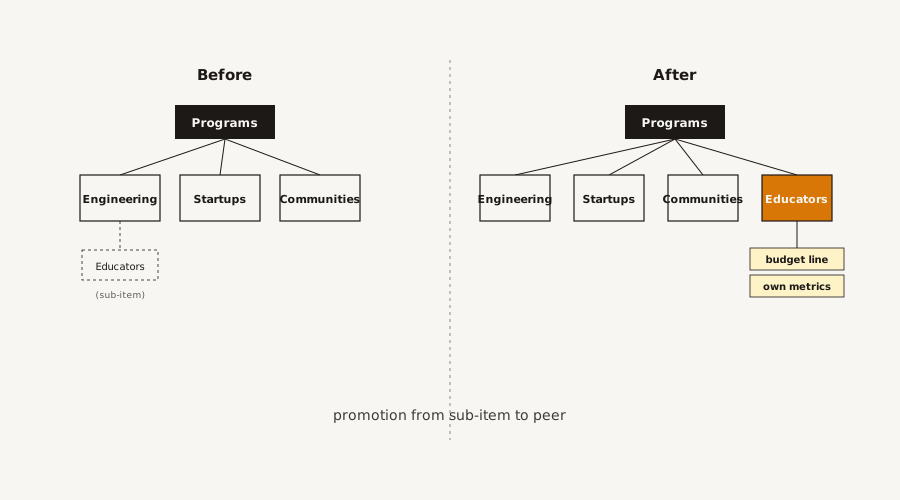
When I joined Google in May 2022, the Educators community existed but sat as a subcategory under the engineering developer programs. It shared a budget line, its metrics were reported inside the parent program, and its leaders were spoken for by the parent's owner at planning tables.
By the time I left in December 2025, Educators had its own line at the India Community Summit, its own OKRs, and a seat in the same rooms as Google Developer Experts and Google for Startups. That was three years of a slow, mostly political argument. This is the teardown.
Subcategory vs first-class
The two words sound like org chart pedantry. They are not.
A subcategory borrows its budget from a parent program, reports into the parent's scorecard, and is represented at planning by the parent's owner. When the parent has a bad quarter, the subcategory gets cut first because it is the easiest thing to cut without touching the parent's core work.
A first-class program has its own line, its own metrics, and its own owner. When it has a bad quarter, it has to defend itself, which is the healthy version. When it has a good quarter, the returns accrue to it, not to a parent whose leadership might not even notice.
Moving from one to the other is the difference between a programme that survives budget cycles and a programme that compounds through them.
The argument I had to make
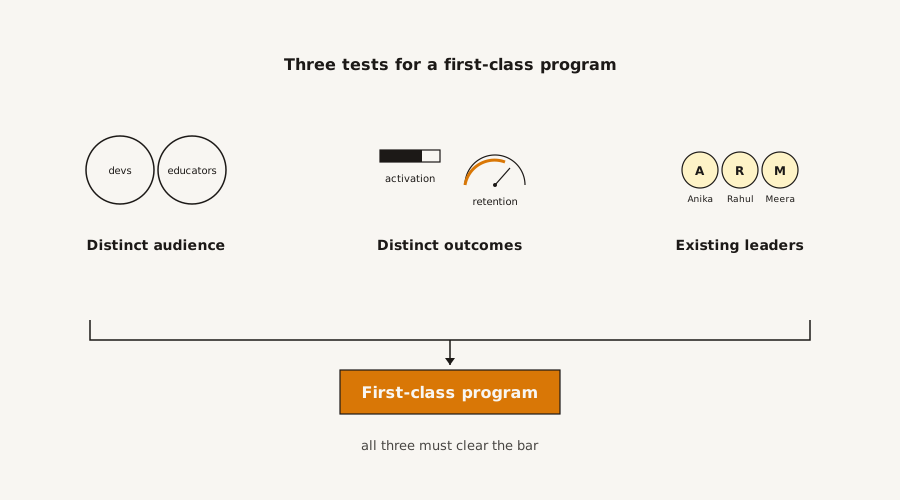
The argument that eventually landed had three parts. Each of them took time and evidence to establish.
| The claim | What made it credible |
|---|---|
| The audience does not overlap with existing categories | Educator leads are faculty and department heads. GDG leads are practitioner developers. GDE leads are recognised experts. The overlap in real people running these communities was small |
| The outcomes are measured differently | Educator programs are measured on curriculum reach, faculty adoption, and student cohort completions. Engineering programs are measured on API adoption and product depth. These metrics do not aggregate |
| The leaders already exist and do the work | The Educators community had active leads across 200+ institutions before formal recognition. Their work was already happening; the question was whether the org would treat it as a category |
Any one of these on its own could be countered. A different audience? Then run different sub-events. Different metrics? Then report them as a subsection. Existing leaders? Then formalise them under the parent. Together the three make the counter-argument expensive: you would have to fake the shape of a first-class program without giving it the line item.
The India Community Summit was where the framing changed
Talking about a category in the abstract does not move it. Putting it on the agenda of a room the org already treats as important does.
The India Community Summit is Google for Developers' invite-only annual summit for India's community leaders — GDG organisers, Google Developer Experts, TensorFlow User Group leads, gaming, and startup organisers in one room. I was on the core organising team every year from 2022 to 2025 and served as the Educators Lead.
The first year, Educators had a shared segment inside a broader session. By 2024, Educators had its own segment on the main agenda. That change is what most external observers would call the moment the category landed. From the inside, that segment was the outcome of two years of the argument above being made in smaller rooms first. The summit was the public read of what had already changed.
What actually moved the needle
Three specific things did most of the work.
Bringing global stakeholders to India events. A category becomes real when someone with global scope sees it in operation. The India Edu program spanned 200+ institutions and 200K+ learners; the metrics on paper only matter if a global lead has watched a faculty cohort actually work through a Gemini enablement module. Once they had, the argument for a category was made twice — once by me and once by their own recollection.
Details on the India Edu Program: how the partner network drove 60K+ Gemini API adoptions.
Reporting Educator metrics separately. Not as a subsection, not as an appendix. A standalone slide with faculty adoption, cohort completion, and language coverage. Once the metrics had their own slide, the budget line was a formality.
Naming the leaders on the record. Faculty champions, chapter organisers, curriculum authors. When those names appeared on public Google channels — event stages, blog posts, summit lists — the community stopped being abstract. It became a set of specific people the org could point to.
If you are trying to move a program from subcategory to first-class
- Prove distinct audience, distinct metrics, and existing leaders. All three, not any one.
- Report your metrics on their own slide, not as an appendix in the parent's deck.
- Get global stakeholders to see the program working in person. Recollection is a stronger argument than a paper.
- Name the leaders. A community without named leaders reads as an abstraction.
- Take the public stage moment when it arrives. That is the moment external readers date the category from.
What this cost
Three years. Most of it in small internal rooms nobody remembers being in. A category is a political outcome. It is not decided at a summit. The summit is where the decision becomes visible.
Related: why DevRel gets cut first when budget tightens, and the metrics that survive a budget review.